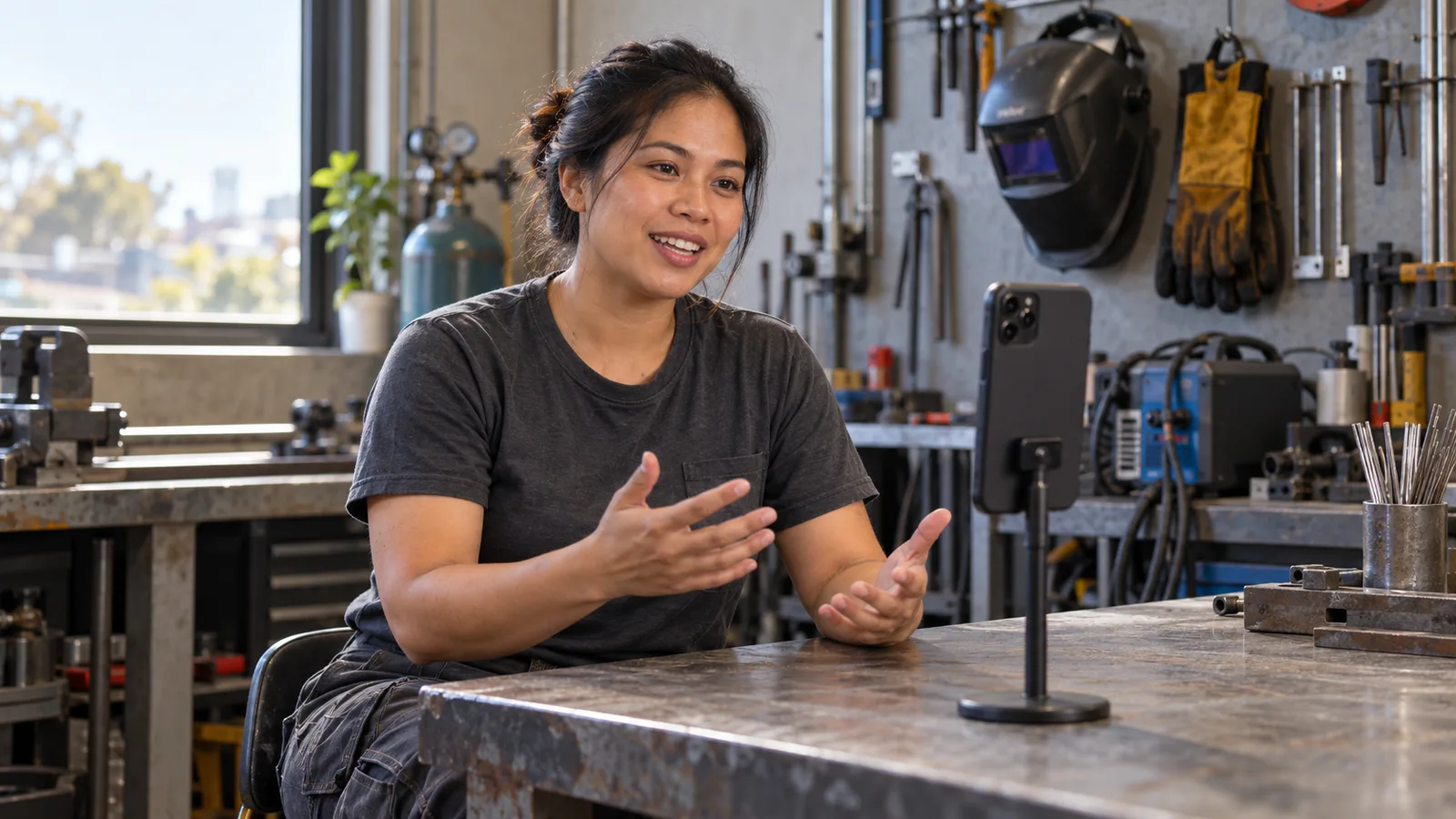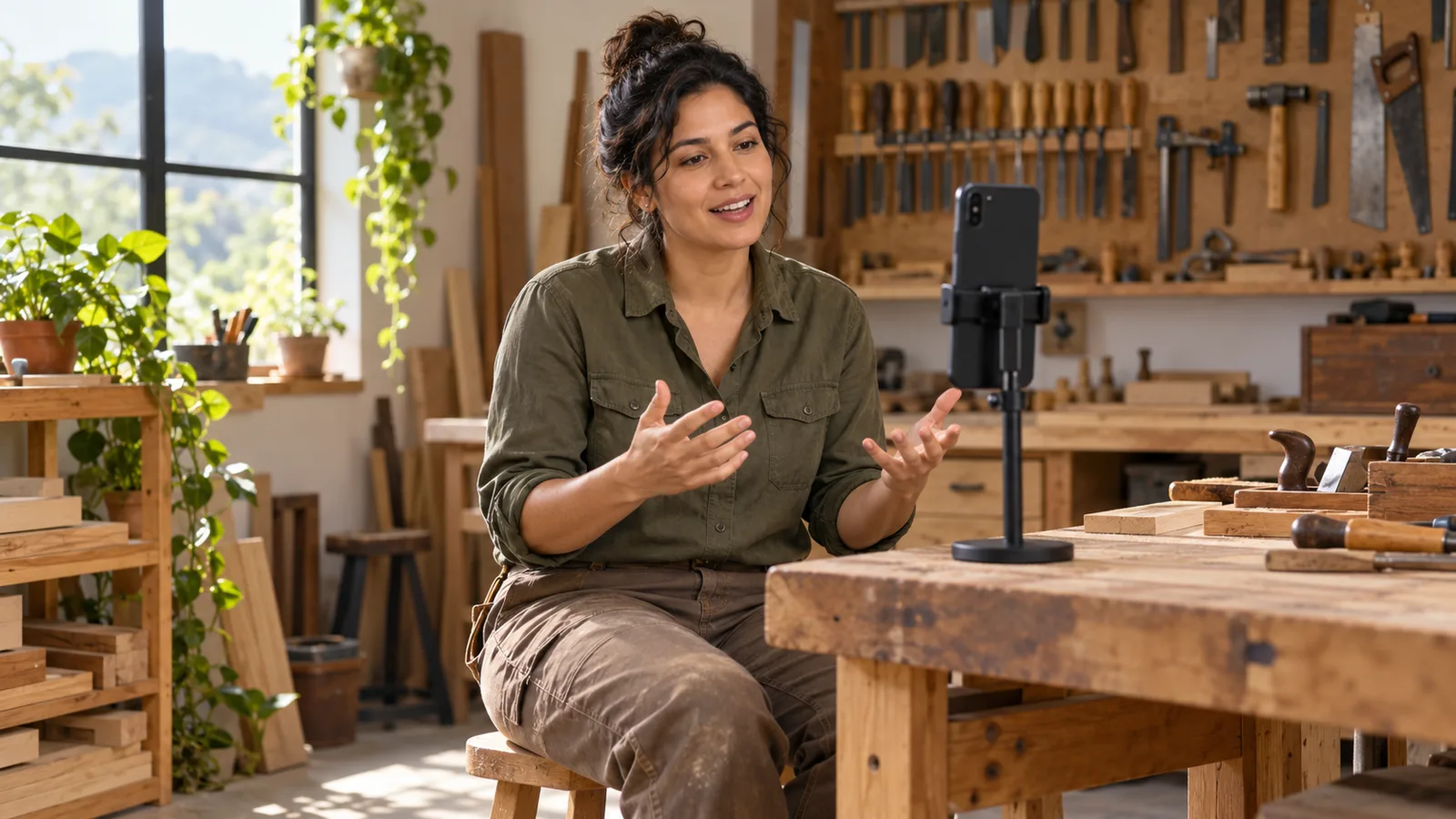

To speak confidently on camera when English is your second language, aim for clear, not perfect. Slow down, use short sentences, pause after each idea and practise your key lines out loud until they feel normal in your mouth. Your accent is part of you. What counts is that an employer can follow what you say and hear that you know your trade.
Why clear beats perfect
Many people freeze in front of a lens because they are chasing flawless grammar. A short self-introduction is not a grammar exam. A mechanic is hired to fix engines, and the video is simply a chance to show you can explain that work calmly.
New Zealand's Human Rights Commission says an employer cannot refuse to hire you because of your accent if you can be clearly understood, and that a New Zealand accent is rarely a genuine requirement for a job. In Australia, the Australian Human Rights Commission gives the example of a migrant with excellent English passed over for a hotel job because the manager wanted nobody with an accent, and says she may make a race discrimination complaint.
Slow down and let the pauses work for you
Nerves make almost everyone speed up. The Australian Government's advice for job seekers says nerves can make you talk faster than usual or miss important points, and that practising answers to common questions helps calm them.
Tahatū Career Navigator, the New Zealand government's careers website, says much the same: take a deep breath before you start talking to an employer, then try to talk slowly and clearly.
Pauses give the listener time to catch your meaning and give you a moment to find the next word. On video, a pause looks relaxed rather than lost. Rest briefly at every full stop.
Prepare short sentences and your trade words
Long sentences are where second-language speakers usually trip. Give every idea its own sentence.
Next, make a list of the trade words you will say: tools, machines, materials and tasks taken from the job ad. Say each one aloud until it comes out smoothly, and swap any word that keeps tangling your tongue for a plainer one.
An example for an electrician: "My name is [your name]. I am an electrician from [your city]. I install and repair wiring in houses and small shops. I test every circuit before I finish a job."
The Australian Government's advice for job seekers suggests writing your key points first and practising them aloud many times, so you sound professional without sounding like you are reading. For ready-made lines you can adapt, see these 60-second job intro scripts.
Practise out loud and record yourself
Reading your script in your head is not rehearsal. Tahatū Career Navigator advises practising your answers out loud, by yourself or with someone you trust.
Filming yourself shows problems quickly. The Australian Government's Job Jumpstart site suggests recording your answers and watching them back to see how you come across on screen. The UK's National Careers Service also recommends practice runs where you record yourself, speak clearly and avoid going too fast.
When you play it back, ask: could a stranger understand every word, and were your eyes on the lens?
Breathing, posture and eye contact
Before you press record, sit tall, feet flat on the floor, and breathe slowly in through your nose and out through your mouth a few times.
The Australian Government's advice for job seekers says to keep good posture, try not to fidget, make regular eye contact and avoid crossing your arms, which can make you seem closed off. Tahatū Career Navigator also suggests avoiding too many hand gestures on video.
On a phone, eye contact means looking into the small lens, not at your own face on the screen. Job Jumpstart's video interview checklist explains that looking at the camera makes your eyes more likely to line up with the interviewer's.
If body language in your culture is different, that is not a fault. The Australian Human Rights Commission says interviewers should not make assumptions from body language that may come from a person's cultural background.
What to do when a word disappears
Losing a word happens in every language, including your first one. How you recover matters more than the slip.
In a recorded self-intro
Here you are in control. Stop, breathe and start the sentence again. The Australian Government's advice for job seekers says to do as many takes as you need until you are happy. For lighting, sound and phone set-up, read how to record a self-intro video on your phone.
In a live video interview
A live call cannot be edited, but you can still pause. If a word will not come, describe it: "the machine that bends steel pipe" works as well as the exact name. Then keep going.
If you did not understand a question, say so. Tahatū Career Navigator's interview tips say you can ask for a question to be explained or repeated, and that you can take time to think, for example by saying it is a good question and you would like to think about it.
Learn a few rescue phrases by heart so they come out even when you are nervous: "Sorry, could you repeat the question, please?", "Do you mean...?" and "Let me think about that for a moment."
Video calls often carry a small delay. The National Careers Service guide to video interviews suggests pausing after each question before you reply.
Quick fixes for common camera problems
| Problem | Quick fix | Practice idea |
|---|---|---|
| Talking too fast | Stop briefly at every full stop | Tap the table at each full stop as you read |
| Forgetting the next line | Use key points instead of a full page of text | Speak from a card with only your key words on it |
| Tripping over trade words | Swap a hard word for a plainer one | Say each trade word alone, then inside a full sentence |
| Eyes on the screen, not the lens | Put a dot of tape next to the lens | Film a test clip and check where you look |
| Flat, stiff voice | Smile and let your tone rise and fall | Say one line to a friend, then the same line to an imagined employer |
| Worry about your accent | Aim to be understood, not to sound local | Ask someone you trust whether they caught every word |
A 7-day practice plan
This is a simple shape for your week, not a rule. A short session each day is enough.
- Day 1, write it. Put your intro into short sentences: your name, your trade, your experience, your main skills and the job you want. Underline trade words.
- Day 2, say the words. Practise each underlined word aloud until it feels easy.
- Day 3, read it slowly. Read the whole script aloud, resting at every full stop.
- Day 4, film a test. Record yourself on your phone. Watch once for clear speech and once for eye contact.
- Day 5, drop the script. Turn the script into key points and speak from those.
- Day 6, rehearse the hard moments. Ask a friend to throw in a surprise question. Practise asking them to repeat it and taking a moment to think.
- Day 7, record for real. Set up your light and phone, breathe and film. Retake as often as you need, then keep the best one.
Building your spoken English beyond the video
Talking on camera and sitting a speaking test share many skills, though the formats differ. The IELTS website says its Speaking test is a face-to-face interview with an examiner and that it is recorded. The Pearson PTE help centre says PTE Academic is taken at a secure test centre on a computer with a headset.
If a test is part of your plans, steady speaking practice helps on both fronts. You can practise IELTS or PTE speaking tasks with PractiseNow. Practice builds confidence, but nobody can promise you a score.
If you are applying from the Philippines
If you are a cook in Cebu or a welder in Davao filming an intro for work overseas, everything above applies to you. At home you may mix English with Tagalog or Bisaya, which is normal. For the video, stick to the English trade words used in the job ad, so the employer hears the same terms they wrote.
When you are ready to see what roles are out there, you can browse jobs abroad on PinoyAbroad. A good video helps you introduce yourself, but it is not a job offer, and no website can promise you one.
Watch for scams wherever the job is. Scamwatch, the Australian Government's scam advice service, says being asked to pay a recruitment fee or to pay for training materials before you start is a warning sign.
How SelfIntroVideo helps you rehearse
SelfIntroVideo has a practice mode with a teleprompter you can set between 100 and 180 words per minute, and it pauses briefly at full stops and commas, so the pauses are built into your rehearsal. See the full list on the SelfIntroVideo features page or read how the app works. The Android app is not on Google Play yet but is coming soon, and an iPhone version will follow later.
Common mistakes second-language speakers make on camera
- Copying an accent that is not yours. Forcing a different accent usually makes you harder to understand. Use your own voice, slowly.
- Reading word for word. Your eyes drop and your voice goes flat. Learn key points instead.
- Rushing to the end. Speed hides your best points. Tahatū Career Navigator advises keeping answers brief and to the point, and brief does not mean rushed.
- Giving up after one bad take. The first recording is rarely the best one.
Rules and requirements can change. Check the official government website before you act.
Frequently asked questions
Is it a problem to have an accent in my self-introduction video?
An accent on its own is not a mistake. In New Zealand, the Human Rights Commission says an employer cannot refuse to hire you because of your accent if you can be clearly understood. Put your effort into speaking slowly and clearly, not into changing how you sound.
Can I read from a script when I record?
Yes, but practise it aloud many times first. The Australian Government's advice for job seekers says this helps you come across as professional without sounding like you are reading.
What if I forget a word in a live video interview?
Pause, breathe and describe the thing in simpler words, then carry on. If you did not catch a question, you can ask for it to be repeated or explained, as both Tahatū Career Navigator and the National Careers Service say.
How can I stop feeling nervous on camera?
Regular practice is the most reliable help. The Australian Government's advice for job seekers says practising answers to common interview questions can calm your nerves. Record yourself, watch it back, and fix one small thing each time.
Do I need an English test before I record a self-intro video?
No. A self-intro video is not a test, and whether you need an English test depends on the visa or job you apply for. Check the official government website for that visa before you plan.
Key takeaways
- Clear beats perfect: an accent is fine when people can understand you.
- Slow down, use one idea per sentence and pause at every full stop.
- Prepare your trade words and practise them out loud, then record and watch yourself.
- Look at the lens, sit tall and breathe slowly before you start.
- In a recorded video you can retake; in a live interview you can ask for a question to be repeated.