
A strong "tell me about yourself" answer for a tradesperson lasts about one minute and has four parts: your trade and years in it, the experience behind you, one skill with a short example, and the job you want next. Below you will find a plan for each part, five sample answers to adapt, what to leave out and how to practise. It is written for workers who speak English as a second language and apply for jobs in Australia, New Zealand, the UK, Canada or the Gulf.
Why employers open with this question
This is not small talk. The Australian Government's advice for job seekers says employers ask "Can you tell me about yourself?" to get an idea of who you are, your work-related experience and skills, and how you will fit into the team.
New Zealand's official careers service, Tahatū Career Navigator, suggests you sum up your work experience and qualifications, then talk about your goals. Its interview tips on Tahatū are worth reading. The Australian Human Rights Commission also lists "Tell me a bit about yourself and your professional skillset" among the common questions to prepare. So have your answer ready, whichever country you apply to.
How long your answer should be
Aim for about one minute. Tahatū suggests a short kōrero (a talk) about yourself that takes no more than 60 seconds to say, and advises keeping answers brief, with examples from your own work. That is only eight to ten simple sentences.
The 4-part structure: present, past, skills, future
Use the same order every time, so you never wonder what comes next.
| Part | What to say | Example line |
|---|---|---|
| 1. Present | Your trade, your level and how long you have worked in it | "I am a diesel mechanic, and I have spent eight years in heavy vehicle workshops." |
| 2. Past | Where your experience comes from: employers, sites, machines or kitchens | "I began as an apprentice on trucks and buses, and now I maintain a mining fleet." |
| 3. Skills | One or two skills that match the job, with one short example | "Fault finding is my strength. Last month I traced a wiring problem that had stopped a haul truck for days." |
| 4. Future | The job you want and why this employer | "I want to join your team because you service the same engines I know best." |
The Australian Government's advice says you can use this question to highlight past experience and show you have the skills for the job, with examples that relate to the role. So part 3 needs something that really happened, not just "hardworking".
Part 4 is easy to forget. Job Bank's advice for newcomers from the Government of Canada says to be ready to explain why you want to work there, the value you will add and how you did well in earlier jobs.
Sample answers for five trades
These are examples only. Use your own trade, years, tasks and reasons, and never claim experience you do not have: New Zealand's Human Rights Commission says an employer can withdraw a job offer over exaggerated qualifications or experience.
Example for a motor mechanic
"My name is [your name]. I am a motor mechanic with seven years on cars and light trucks. I trained in a dealership and now work in a busy independent garage, doing services, brakes, suspension and engine repairs with scan tools. Customers ask for me again because I explain problems in simple words. I am applying because your workshop looks after the Japanese brands I know well."
Example for an electrician
"Hello, I am [your name]. I have worked as an electrician for nine years, the last four with a contractor on shop fit-outs and apartment blocks. I pull cables, install switchboards and lighting, and test every circuit before handover. I isolate and check before every task, so my team trusts me with final checks. I want this position because you work on large commercial projects."
Example for a welder
"I am [your name], a welder and fabricator. I started six years ago making gates in a small steel shop, and now I build structural steel for factories. I weld MIG, TIG and stick in all positions and work from drawings. On my last project the inspector passed every joint on a warehouse roof frame first time. Your role interests me because you fabricate steel for construction."
Example for a chef
"My name is [your name], and I cook for a living. I began as a kitchen hand ten years ago and have been sous chef in a hotel restaurant for three years. I plan menus, order stock and teach junior cooks food safety. Last year I helped our kitchen waste less by changing how we prepare vegetables. I want to join your kitchen because you cook fresh, seasonal food."
Example for a carpenter
"Hi, I am [your name]. I have been a carpenter for eleven years, starting on concrete formwork and now building frames, roofs and stairs for new homes. I set out the work, follow the drawings and lead a crew of two or three. My supervisor gives me the stair jobs because I am careful with measurements. I am applying because your company builds quality homes."
Each sample has a trade and years, real tasks, one skill with proof, and a reason that names the employer. Check your own answer has all four.
What to leave out
- Your life story. Start with your trade, not your school days.
- Personal life. Marriage, children, religion and health do not belong here. In the UK, GOV.UK tells employers not to ask applicants whether they are married or have or plan to have children. The Australian Human Rights Commission says you can complain about unfair treatment at work because of race, age, religion or disability, among other reasons.
- Salary. Leave pay until the employer raises it.
- Visa worries. Keep paperwork worries out of your answer. If asked about your right to work, answer simply and honestly. New Zealand's Human Rights Commission says all applicants should be asked whether they are entitled to work in New Zealand.
- Complaints about past bosses. The Australian Government's advice says criticising past employers can reflect poorly on you.
A hobby can stay if it says something good about you. The same Australian advice gives weekend soccer as an example of showing commitment and teamwork.
Applying in Australia? Mention your qualifications
The Australian Government's Your Career site says employers generally look for the right qualifications and/or work experience plus employability skills. So add one line about your qualification in part 1 or 2, such as "I hold a trade certificate in welding from my home country."
Learned your trade on the job? Your Career explains that Recognition of Prior Learning (RPL) is a formal process that assesses skills gained through work, life experience or previous study, and can help you achieve a qualification faster. See its guide to real skills and RPL, or read how RPL works for trade workers to see how skills from work can be recognised in Australia. Any result depends on a proper assessment, and Your Career warns against providers that promise fast qualifications or skip one. In your answer, say only what you hold today.
How to practise your answer out loud
Tahatū advises practising answers out loud, alone or with someone you trust. The Australian Government's advice adds that nerves can make you talk faster or miss points, and practice helps calm them.
- Write four notes, one key word or phrase for each part.
- Say the answer from your notes and time it on your phone.
- Cut anything extra until it fits into about one minute.
- Record yourself and watch it back. The UK's National Careers Service suggests recorded practice runs, speaking clearly and not too fast.
- Say it to a friend, then ask what they remember. If they cannot name your trade and your example, make those parts clearer.
- Repeat for a few days, changing some words so it never sounds learned by heart.
The National Careers Service also advises keeping examples brief and speaking naturally. To hear how your spoken answers come across, you can practise interview questions out loud on InterviewTraining.ai. And if a question is unclear on the day, Tahatū says you can ask for it to be explained or repeated.
Turning your answer into a self-introduction video
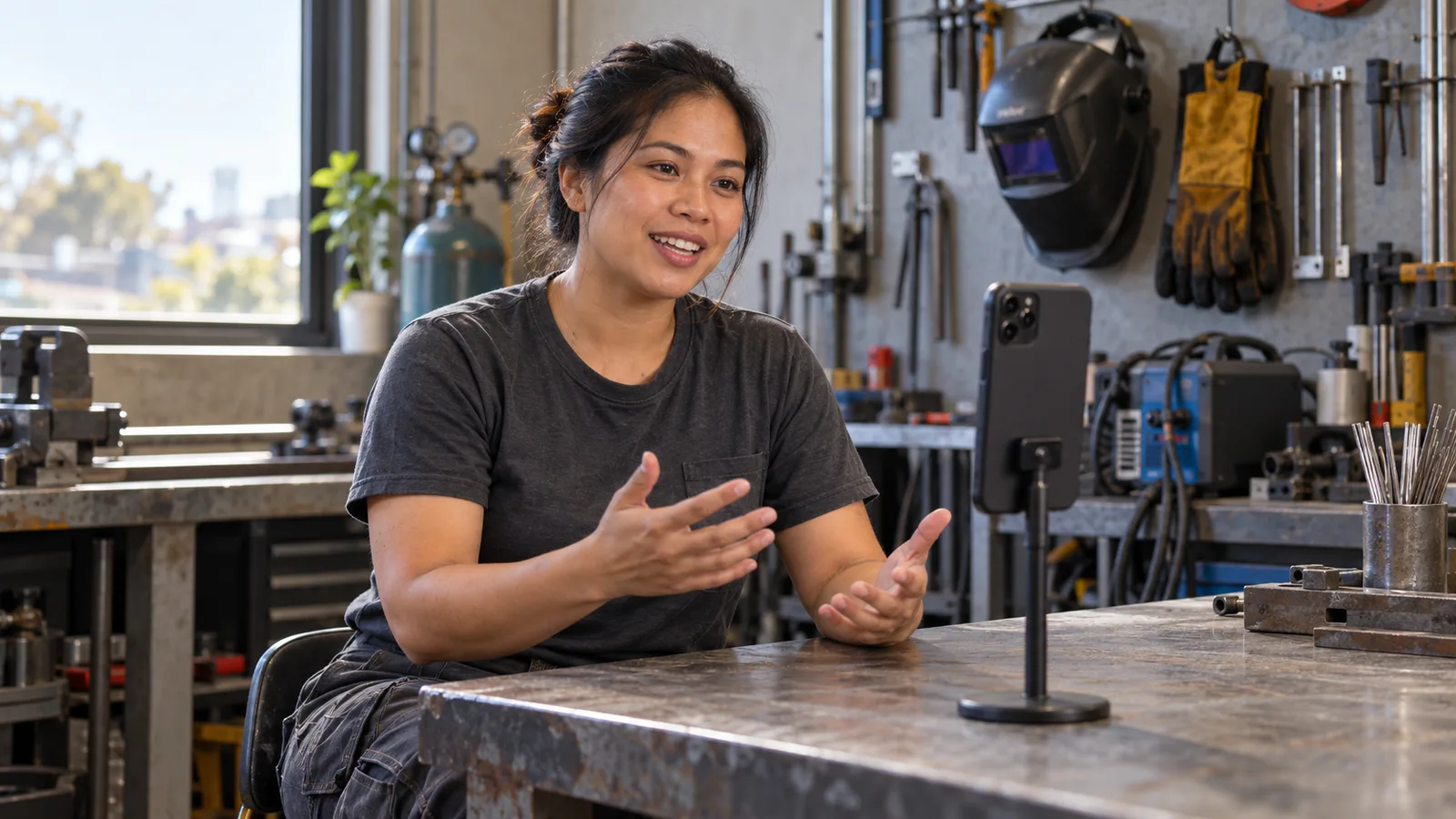
The same four parts work on video. The Australian Government's advice says a video resume should introduce you and summarise your relevant education, experience and achievements, kept under 2 minutes. For an intro video, aim for about one minute.
- Say your name and trade in the first sentence.
- Practise key points aloud many times so you do not sound like you are reading, as the same Australian advice suggests.
- Finish with thanks and how to contact you, as Tahatū advises for a video CV.
- Look at the lens, face the light and film somewhere quiet.
For filming, read our guide to recording a self-introduction video on your phone, and see our page for job seekers.
SelfIntroVideo can help: it writes a script from your Talent Tabloid profile (target role, skills and experience) and shows it on a teleprompter while you film. The Android app is coming soon to Google Play. See how SelfIntroVideo works or the SelfIntroVideo FAQ.
Common mistakes with "tell me about yourself"
- Opening with your childhood. It uses your best seconds and tells the employer little.
- Repeating your resume line by line. The employer has it. Pick what fits this job.
- Qualities with no proof. "Honest and hardworking" means little without an example.
- Rushing. Tahatū advises taking a deep breath and talking slowly and clearly.
- The same reason for every employer. Part 4 should name this company or job.
- Trailing off. End on the job you want, not "so, yes, that is it".
Rules and requirements can change. Check the official government website before you act.
Frequently asked questions
How long should a "tell me about yourself" answer be?
About one minute. New Zealand's Tahatū Career Navigator suggests a short talk about yourself that takes no more than 60 seconds to say. That fits your trade, your background, one skill with an example and the job you want.
Can I use the same sample answer for every job?
Keep the four-part structure, but change the details. Pick the skills and example that match each job ad, and give a reason for wanting that employer. A general answer sounds as if it could be for any company.
Should I memorise my answer word for word?
No. Learn the four parts and your key points, then use slightly different words each time you practise. The Australian Government's advice for job seekers says practising key points aloud helps you avoid sounding like you are reading a script.
What if my English is not strong?
Use short sentences and words you already use at work. Speak slowly and pause between the parts. If you do not understand a question, you can ask the interviewer to repeat or explain it.
Is "tell me about yourself" the same as a self-introduction video?
The content is almost the same. On video you speak to the camera, so you say your name and trade first and finish with thanks and contact details. One well-prepared answer can do both jobs.
Key takeaways
- Employers ask this to learn who you are, what you can do and how you will fit in.
- Keep it to about one minute in four parts: present, past, skills, future.
- Back up one skill with a short, true example.
- Leave out personal life, salary and visa worries; answer work-rights questions honestly.
- Practise out loud from notes, then reuse the answer for your intro video.