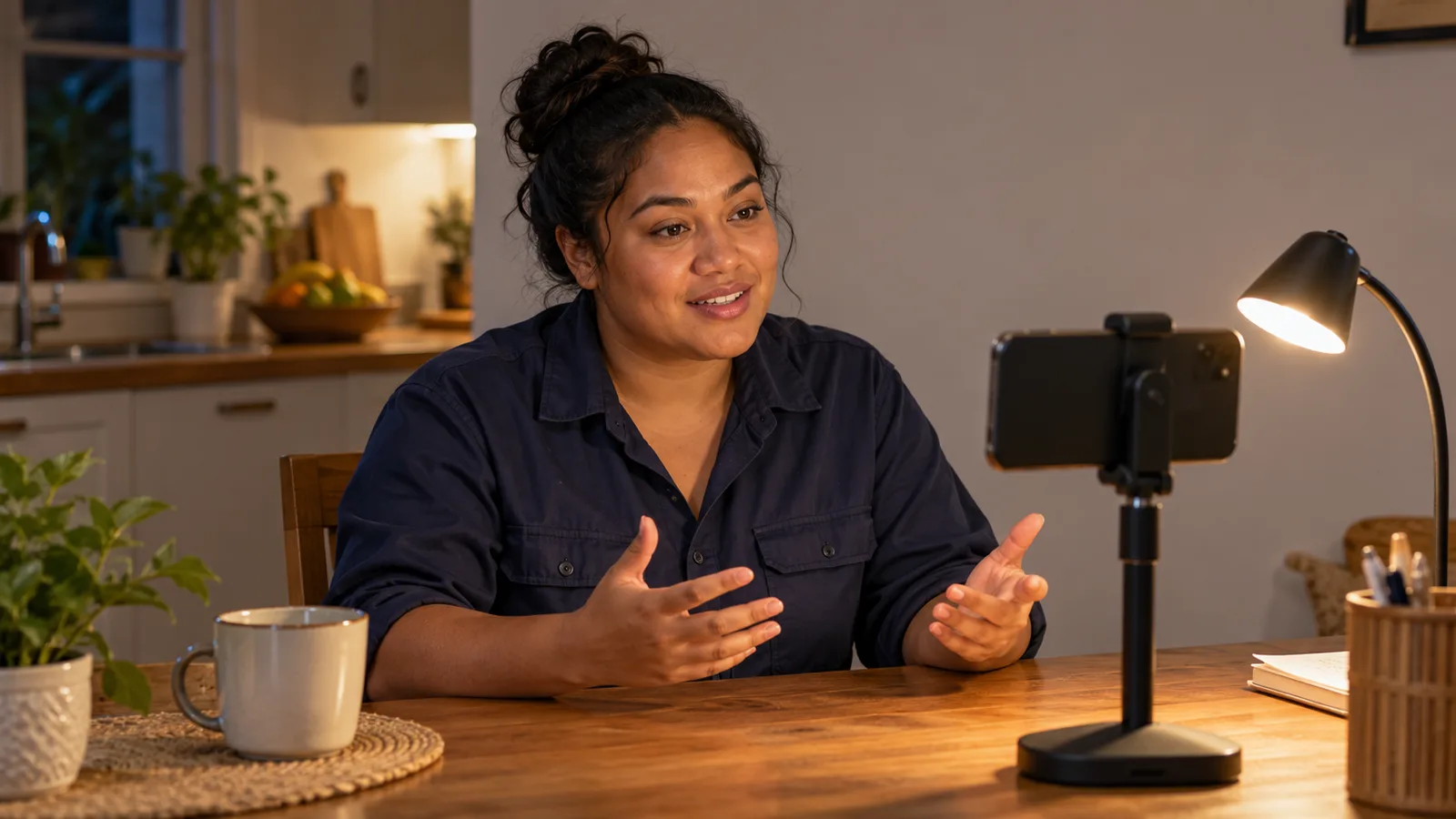
A video resume for an Australian employer should be short, clear and honest: about one minute, filmed on your phone, with your name, your trade, your licences and one real example of your work. The Australian Government’s advice for job seekers says a well-made video resume can give you an edge over other candidates, but a poor one can work against you. This guide shows what to say and what Australians expect to see.
What a video resume is, and what Australian employers use it for
A video resume is a short clip where you introduce yourself to an employer before you meet. It does not replace your written resume. The official advice says it should introduce you and give a summary of your relevant education, experience and achievements.
Many employers read a resume first and watch the video second. They want to hear your English, see how you present yourself and decide if you are someone they would like to talk to. If you want to compare the two formats, read our guide to a video CV and a paper CV.
Use the words employers use. In Australia the written document is called a “resume” or “CV”, and a “tradie” is a person who works in a trade. The question “tell me about yourself” is common, because the government’s advice for job seekers says employers ask it to learn who you are, your work experience and skills, and how you will fit into the team.
What Australians expect to see and hear
Australian advice is plain and practical. There is no special style you must copy. These points come from the Australian Government’s advice for job seekers on video resumes:
- Length: keep the video under 2 minutes, because attention drops with anything longer.
- Equipment: you do not need expensive equipment. The camera on your phone should work well.
- Direction: film with the phone sideways (landscape), because it is easier to view.
- Camera height: put the lens just above your eye level and tilt it down. Never film from below.
- Background and light: choose a clear, well-lit background such as a blank wall, with a window behind the camera so the light falls on your face.
- Sound: the audio should be clear, with no background noise.
- Clothes: wear what you would wear to an interview in person.
For a long list of these small rules with reasons, see our 12 video resume tips.
What to say: five parts for one minute
The same advice says to write your key points first and practise saying them aloud many times, so you sound professional without sounding as if you are reading. Five short parts are enough. The table gives a plan and an example line for each part.
| Part | What to say | Example line (change the details) |
|---|---|---|
| 1. Name and trade | Your name, your trade and your years of experience. | “Hello, my name is [your name]. I am an electrician with [number] years of experience.” |
| 2. Your work | The kind of sites or places you work in and the tasks you do each day. | “I install and test wiring in houses and small shops.” |
| 3. Licences and checks | Your licence or ticket, and the status of any skills assessment, said honestly. | “I hold my trade licence from [country]. I have applied for a skills assessment.” |
| 4. One example | One real job: the problem, what you did and the result. | “On one job the power failed at night. I found the fault and fixed it before morning.” |
| 5. The ending | Thank the viewer and say how to reach you. | “Thank you for watching. My details are on my resume.” |
For many more lines by trade, see our tell me about yourself answers for tradespeople. If the minute feels too short, our guide to video length shows what to cut first.
How to talk about licences and skills assessments honestly
Australian trade employers care about licences, tickets and proof of skill. The government’s advice for job seekers says to list relevant licences, such as a driver’s licence or a first aid certificate, with the expiry date of each one. Do the same on camera: name the licence and say it is current.
Many occupations also have a skills assessment. Home Affairs explains that a skills assessing authority is an organisation that checks that a person’s skills meet its standards for an occupation, and Home Affairs only accepts an assessment from the relevant authority. A skills assessment with no validity period shown is valid for 3 years from the date it was issued.
For some employer-sponsored work visas, such as the subclass 482 visa, a skills assessment can be mandatory and must be started before the visa application is lodged. That is the visa side. In the video, only describe your own situation, and only what is true:
| Your situation | A safe, honest line |
|---|---|
| You have a skills assessment | “I have a skills assessment for my trade, issued in [year].” |
| You have applied | “I have applied for a skills assessment for my trade.” |
| You have not applied yet | Talk about your licence, your years of work and your tickets. Do not suggest you have an assessment. |
| You have experience but no paper | Say what you can do and what you have done. Leave out any claim about a qualification you do not hold. |
If you have skills from work but no formal certificate, a process called Recognition of Prior Learning can assess them. The government’s Your Career site describes it as a formal process that assesses skills and knowledge gained through work, life experience or previous study. You can read about qualifications for Australian work at RPLDirect. A qualification does not by itself decide what an employer or a visa office will accept, so describe it exactly as it is.
Keep the video about your work, not your papers
Do not talk about your age, marriage, children or religion. The Australian Human Rights Commission says you can complain if you are treated unfairly at work because of things like race, age, religion or immigrant status. Because that is the rule for employers, you gain nothing by offering the details.
Work rights are different from personal details. The Commission says an employer does not have to employ someone who has no valid work visa. If a job ad asks about your right to work, answer clearly on your resume or in the form. The video does not need the long story.
Never show your passport or identity card on camera, and be careful with any employer you have not checked. Scamwatch says never to send your passport or identity documents to an employer or recruitment firm unless you are certain they are genuine. If you are not sure what else to leave out, our list of self-introduction video mistakes covers it.
How to make your video: steps
- Read the job ad. Note the trade words, the licences and the keywords it uses. The official advice says to use the same keywords the employer uses.
- Write five key points, one for each part in the table. Do not write a speech.
- Practise aloud until the points feel natural, then record several takes. The official advice says to do as many takes as you need and to ask a friend for feedback.
- Film in landscape, with the lens just above eye level, a plain wall behind you and the window behind the camera. For the phone steps, see how to record a self-introduction video on your phone.
- Watch it back with the sound on. Check the light on your face, the sound and the length.
- Send it the way the employer asks. If you use a link, the official advice suggests setting a YouTube video to unlisted so it does not appear in search results.
Make the video match your resume
Your video and your written resume should tell the same story: the same trade, years and licences. The official advice says a finished resume should be about 2 pages, and it says to check that everything in it is true and correct. A tool such as Build AI CV can help you put a clear resume together, and you check every line yourself.
If you are applying from another country, our guide to changing one base video for five regions shows which parts to keep and which to change for Australia.
Where the app can help
SelfIntroVideo is an Android app that writes a script in plain English from your Talent Tabloid profile and shows it on a teleprompter while you record. The Android app is coming soon and is not on Google Play yet. An iPhone version is coming later. You can read how it works on the how it works page or see the page for job seekers.
Common mistakes
- Too long. More than 2 minutes loses the viewer. Aim for about one.
- Reading a script word for word. Practise the points until you can say them in your own words.
- Claiming an assessment you do not have. Say “applied” if you applied. Honest wording protects you at the interview.
- Filming with a window behind you. Your face turns dark. Put the window behind the camera.
- Talking about family, age or religion. It is not needed, and it is not what employers ask for.
- Sending the same last line to every job. Change it to match the ad.
Frequently asked questions
How long should a video resume for an Australian employer be?
The Australian Government’s advice for job seekers says to time your video resume and keep it under 2 minutes. For a trade job, about one minute is usually enough. If the job ad or the form gives a limit, follow that limit.
Do I need a video resume to get a job in Australia?
No. A video is an extra, not a rule, and a job ad will say if it wants one. Your written resume and any licences still do the main work, and the video only adds your voice, your face and one real example.
Should I say that I need visa sponsorship in my video?
Keep the video about your work. If the job ad asks about your work rights, answer in one honest sentence on your resume or in the form. Never pay anyone for sponsorship or for a job that needs sponsorship, because the Fair Work Ombudsman says that is illegal.
Will my accent count against me?
Speak clearly and slowly, and do not worry about sounding perfect. The Australian Human Rights Commission gives an example of a migrant with excellent English who was not put forward for a job because of her accent, and says she may make a race discrimination complaint.
Can I send the same video to every employer?
You can keep one base video, but change the last line for each job. The Australian Government’s advice for job seekers says to write a new application for each job and use the same keywords as the ad, and the same idea works for the spoken part.
Rules and requirements can change. Check the official government website before you act.
The official pages behind this guide: the Australian Government’s video resume advice, its resume advice, Home Affairs on skills assessments and the Fair Work Ombudsman for visa holders.
Key takeaways
- Keep your video resume to about one minute, and under 2 minutes at the most.
- Use five parts: name and trade, your work, licences and checks, one example, a thank you.
- Say your licence and skills assessment status exactly as it is.
- Film in landscape with the lens at eye level and the window behind the camera.
- Leave out age, family and religion, and never show your passport.
- Change the last line for each job and match your written resume.